Category Archives: Uncategorized

On Organizational Readiness

I have recently (and not for the first time) been in conversations with other nonprofit professionals regarding how to be most supportive to individuals and groups who are seeking to make a difference within their communities via organized, grassroots community-based efforts.  Quite often, these individuals or groups have created or are in the process of creating tax-exempt, nonprofit organizations.  More often than not, the reason they have taken this route (or plan to) is because they have been told that there is grant funding available for nonprofit organizations to help them fulfill their missions.  And this is true.  The Nonprofit Hub reports that there are literally BILLIONS of dollars’ worth of funding available from a variety of sources, for the right organizations doing the right things.  The question, then, is whether yours is that “right” organization, and are you favorably positioned to take advantage of all of these funding opportunities?

What I am finding in my interaction with organization leaders and future leaders is that most want to get to the money — and thus, the work for which it is needed — without doing the necessary foundational work to position themselves favorably to be able to take advantage of the opportunities out there.  I call this “organizational readiness.”

There are several degrees and levels of readiness to which organizations need to attend (new organizations and often even established ones, as well) .   The most basic need is to establish your organization as a tax-exempt nonprofit.  Most funders are primarily interested in funding organizations that have received tax-exempt, charitable purposes status from the federal government (IRS).  Even though an organization may be working without plans to create profit, until the organization has the official status granted by the IRS, you will not be recognized by funders who require this status. Gaining this status is not complicated, but it does require an extensive application process, that can be tricky if you don’t understand it.  It is generally best to work with a nonprofit development specialist to achieve this status.  This is the first step.  It will require a board of incorporators to complete basic planning (e.g. development of articles of incorporation and bylaws, preliminary planning, etc.).  This board may later become the governing board of directors for the organization (required).  As a note, there is a relatively new 501 (c) (3) EZ status that is easier to obtain, especially for new/emerging organizations.  The primary qualifier is that the organization must not have had an annual budget of over $25,000, nor anticipate that they will have over the next year.  For more information, contact the IRS (information available online, as well).

Beyond that, most funders require that you have certain things in place to even be considered for funding opportunities.  These may include:

  • Committed Board of Directors (Governing)
  • Clear vision and mission
  • Coherent strategic plan, including clear organizational and program goals, and objectives
  • Capable management, staff, and volunteers
  • Legal standing to do business in your community
  • Appropriate tax status
  • Accounting systems and financial management protocols
  • Programs that are vital to the well-being of the community
  • Fundraising plan, which seeks support from many different sources (not just grants)
  • Facilities, equipment, and maintenance, as needed and appropriate
  • A track record of service

That last item — a track record of service — is often critical to getting a funder to even consider your proposal for funding, as most funders want some assurances that you are able to deliver whatever project or program you are proposing, and the best assurance is a history of having successfully done the same or similar thing before.  Experience.  Many funders are not interested in funding “new” or “start-up” organizations who do not have a track record of providing the services for which they are requesting funding or serving the constituency for which they plan to work.

For this, I generally counsel emerging organizations to not be afraid to start working, even before having major funding.  Start small.  Build on successes. Utilize volunteers, which has the added advantage of engaging the community in your work while the organization is still young, and creating community buy-in and ownership (another key ingredient for a positive view from potential funders).  Seek small donations from community members and/or small local businesses or other local partners.  Donations need not always be financial (money), but may come in the form of volunteerism, materials, and supplies or other resources.  You will also have the benefit of reporting the financial value of these donations as in-kind contributions to your work.

Strategic planning is also critical, as many funders will ask how the project you are proposing fits into your long-term strategic plan.  Here I will emphasize the difference between a strategic plan and strategic planning. Dwight D. Eisenhower’s is reported to have said that “Plans are useless, but planning is everything.” Put simply, “strategic plans” are often documents that are created (in various ways) but end up in a binder on a shelf somewhere collecting dust. Strategic planning is more fluid, flexible, and adaptive, and requires making constant strategic choices to continue toward meeting the organization’s mission.
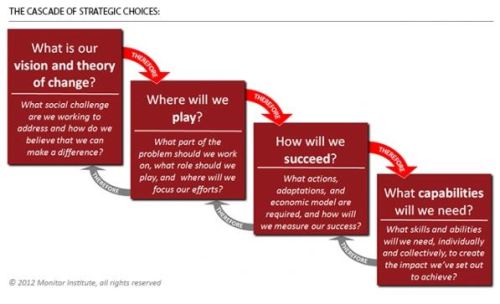
Cascade of Strategic Choices

So…where are you and your organization in terms of “readiness”?  How can we help?
Leave a comment

Filed under Uncategorized

NEW GRANT OPPORTUNITIES (OPEN DEADLINES)

Collective-Impact-Page-GraphicOPEN DEADLINE GRANTS (ALPHABETICALLY)

  • Deadline: Open

    Funding to support the development of natural resource policies and programs that give poor communities more control over these resources and a stronger voice in decision making on land use and development. It focuses its efforts on poor rural communities, indigenous peoples, ethnic minorities and women, in particular.

  • Deadline: Open

    Allstate funds nonprofit organizations in three focus areas, which are broken down into specific program goals.  These focus areas include: safe and vital communities, economic empowerment, and tolerance, inclusion, and diversity.  Grant requests must be for single year requests.

  • Deadline: Open

    Funding to support science, technology, engineering, and mathematics education. Environmental projects, job training, and literacy programs also will be considered.

  • Deadline: Open

    The American Legacy Foundation has given out over $150 million in grants to reduce tobacco use among youth. National and grassroots programs are supported. Community-based efforts and new and better tobacco control programs are encouraged, including Small Innovative Grants and Research Demonstration Projects.

  • Deadline: Open

    Funding to support Higher Education and Scholarship; Scholarly Communications and Information Technology; Art History, Conservation, and Museums; Performing Arts; and Conservation and the Environment.

  • Deadline: Open

    Seeks to assist organizations whose work can help alleviate animal suffering and/or raise public consciousness toward giving animals the respect they need and deserve.

  • Deadline: Open

    Supports local and regional nonprofit organizations that focus on literacy, the arts, or education (K-12). Applicants must be located in the communities where company stores are located and should serve the greater good of the local community or region. A plan for promoting the program with Barnes & Noble should be included in the proposal, and the organization must be willing to work with the local store or stores on in-store programming. Barnes and Noble also provides limited support to national nonprofit organizations that focus on the company’s grantmaking priorities. In addition, eligible applicants may apply for support through a literary-based sponsorship program. Does not award grants.

  • Deadline: Open

    Funding to support organizations with projects involving protecting landscapes and livelihoods threatened by climate change.

  • Deadline: Open

    Funding for organizations supporting community, education, or local capital campaign efforts.

  • Deadline: Open

    Funding to projects that are performed by youth and have real environmental outcomes.

  • Deadline: Open

    Funding to support bible colleges and seminaries, religious causes, liberal arts colleges, medical concerns, and social concerns.

  • Deadline: Open

    Funding to support organizations sharing its commitment to enhancing the health of individuals and families and the well-being of their communities.

  • Deadline: Open

    Through the Water Stewardship focus, The Coca-Cola Foundation supports access to clean water and sanitation, watershed protection, and other programs, including education and awareness programs that promote water conservation. The Healthy and Active Lifestyles focus supports access to exercise, physical activity, and nutritional education programs. Community Recycling is designed to increase litter abatement efforts, advance recovery and reuse, increase community recycling, and support research and innovation. The Education component supports scholarships, as well as drop-out prevention, access to education, and other initiatives. Interested applicants are invited to apply for support at any time.

  • Deadline: Open

    The RBC Blue Water Project hopes to foster a culture of water stewardship so that people have clean, fresh water today and tomorrow by supporting programs that increase watershed awareness in local communities or engage the community in watershed stewardship.

  • Deadline: Open

    Funding to support community focus areas including safety, environment, wellness and community.

  • Deadline: Open

    Veteranscorp.org provides funding for programs that provide opportunities and resources to veterans interested in business or entrepreneurial endeavors.

  • Deadline: Open

    Funding for organizations offering direct aid to children in need, including ill, orphaned, disabled, injured, abused, or malnourished children, as well as those with limited access to education.

  • Deadline: Open

    Funding to support domestic consumption of and access to locally and regionally produced agricultural products, and to develop new market opportunities for farm and ranch operations serving local markets, by developing, improving, expanding, and providing outreach, training, and technical assistance to, OR assisting in the development, improvement, and expansion of: Domestic farmers markets, roadside stands, community-supported agriculture programs, agri-tourism activities and other direct producer-to-consumer market opportunities.

  • Deadline: Open

    Funding in the areas of emergency and disaster relief, child pedestrian safety, and environmental sustainability.

  • Deadline: Open

    Funding to nonprofits that operate in the following areas: Arts and culture, community development and social services, health, and education.

  • Deadline: Open

    Funding for programs that will  provide underserved Americans with the knowledge, skills, and tools necessary for financial success throughout life.

  • Deadline: Open

    Funding to support organizations that provide food, shelter and prevention programs and emergency services.

  • Deadline: Open

    This foundation provides support for nonprofit organizations dedicated to improving the communities served by Food Lion stores. The Foundation supports programs that directly support the academic education of children in primary and secondary education as well as programs that provide meals or food to the hungry.

  • Deadline: Open

    Grants to organizations and filmmakers working to create documentaries with a social conscience but lacking the resources to realize their vision or connect with audiences.

  • Deadline: Open

    Funding to support efforts that protect, promote, and create good jobs with living wages for workers, including low-wage workers.

  • Deadline: Open

    Grantmaking in four main areas: Measuring Progress; Animal Advocacy; Independent Media programs; and Global HIV/AIDS.

  • Deadline: Open

    Nonprofit groups can apply to receive at least three months of free advertising on Google’s website to promote their mission.

  • Deadline: Open

    Allows organizations to electronically find and apply for more than $400 BILLION in federal grants.  It is the single access point for over 1,000 grant programs.

  • Deadline: Open

    Funding to programs that advance the prevention, diagnosis, and treatment of alcoholism, chemical dependency, and addictive behavior.

  • Deadline: Open

    Grants are focused in three areas: community education programs, arts-in-education programs, and agriculture and environmental programs.

  • Deadline: Open

    Funding to organizations that are engaged in community outreach and educational programs that uniquely serve children and adults in the community.

  • Deadline: Open

    Funding to support cultural institutions that offer meaningful programs in the arts and sciences. In particular, the Foundation will prioritize projects which enable engagement by young people and create a lasting impression. Funding consideration will also be given to select programs nurturing and developing artistic talent.

  • Deadline: Open

    Funding for humanitarian efforts, including faith-based endeavors, that strengthen education, fight economic hardships through self-help opportunities, and enhance public health and sanitation.

  • Deadline: Open

    Funding to support organizations that assist the visually impaired, and underprivileged individuals in need of hospital and medical care. The Trust distributes 28 grants per year that have an average value of $1,000 to $3,000, mainly in the Charlottesville and Albemarle areas.

  • Deadline: Open

     Funding to non-profit organizations addressing a variety of community needs and resources with a primary focus on children’s education, financial education and physical education.

  • Deadline: Open

    Funding for programs that better the community through education, conservation and the promotion of a civil society.

  • Deadline: Open

    General support funding for grassroots organizations promoting environmental justice, sustainable agriculture and food systems, and reproductive rights.

  • Deadline: Open

    Funding to support four program areas: developmental disabilities, clean energy, environmental health and regional food systems.

  • Deadline: Open

    Funding to support organizations that operate in the areas of education and health

  • Deadline: Open

    Funding for organizations that promote journalism, advance media innovation, engage communities, and foster the arts.

  • Deadline: Open

    Funding to organizations with projects to improve community quality of life, specifically addressing the areas of hunger relief, youth education, rural leadership, civic improvements, soil and water preservation, and arts and culture.

  • Deadline: Open
    Funding targeting the scholastic development of children and youth by improving elementary and secondary education through support of charter and parochial schools.
  • Deadline: Open

    One time grants of $5,000 – $25,000 for community improvement and public education projects.

  • Deadline: Open

    Funding to local organizations with a charitable purpose.

  • Deadline: Open

    Funding to support and promote quality educational and human services programming.

  • Deadline: Open

    Funding for organizations helping people and places move out of poverty and achieve greater social and economic justice.

  • Deadline: Open

    Advancing Student Achievement, an initiative of the Actuarial Foundation, provides grants to K-12 schools and groups throughout the United States and Canada for programs that involve actuaries in the teaching of mathematics. The focus is on mentoring programs that bring together actuaries and educators in private and public schools, with an emphasis on grades 4-8. The Foundation can provide a local network of actuaries ready to participate, as well as suggestions on how to integrate math concepts from the workplace into the classroom. Groups applying for grants will be given wide latitude in designing programs that enhance learning and create a “love of math” in each student. Applications may be submitted throughout the year.

  • Deadline: Open

    Funding to help young Americans with disabilities maximize their potential and participation in society.

  • Deadline: Open

    Funding to organizations that promote music education for children.

  • Deadline: Open

    Grants to small nonprofits to help cover program related expenses and demonstrably strengthen that organization’s ability to serve its clients and community.

  • Deadline: Open

     Financial assistance and resources to help make the game of golf more accessible to people with disabilities.  The Alliance is particularly interested in applications that demonstrate focus on inclusion of people with disabilities in programs that involve those without disabilities with the ultimate goal of enhancing their inclusion into the fabric of their community.

  • Deadline: Open

    The National Anti-Vivisection Society offers the Sanctuary Fund to provide emergency assistance to animals throughout the U.S. in dire situations which call for immediate intervention. The Fund gives secondary consideration to supporting the relocation of animals that have been used in research facilities, roadside zoos, and/or the entertainment industry, as well as exotic pets and animals rescued from slaughterhouses; wildlife rehabilitation; and innovative approaches to alleviate or prevent animal suffering.

  • Deadline: Open

    Supports conservation activities around the world that contribute significantly to the preservation and sustainable use of the Earth’s biological cultural and historical resources.

  • Deadline: Open

    Bank of America is accepting applications in community development and neighborhood revitalization.  The initiative awards grants of up to $200,000 for leadership training and general operating support for nonprofit organizations.

  • Deadline: Open

    The Norcross Wildlife Foundation provides support to local grassroots organizations throughout the United States that work to protect wild land. Priority is given to organizations that have difficulty raising the modest funds they need to do their critical work in the trenches of environmental conservation. Grants averaging $5,000 are primarily provided for program-related office and field equipment, and public education and outreach materials. The Foundation also provides no-interest loans to local organizations to help them acquire land they have prioritized for conservation.

  • Deadline: Open

    Funding to projects that promote giving children tools for success, building capacity to serve communities, and disaster preparedness and rebuilding.

  • Deadline: Open

    Makes in-kind donations of imprinted goods to deserving organizations.

  • Deadline: Open

    This Institute has several different grant programs for nonprofits and other groups working on research or programs which are designed to promote social justice, political freedom.  Specific focuses of individual grants range from media policy and academic freedom to reducing reliance on incarceration.

  • Deadline: Open

    Large grants for programs related to education, health and wellness, diversity and inclusion, and thought leadership.

  • Deadline: Open

    The mission of this grantor is to raise the quality of life for pets and people who love and need them. Grants are provided to local nonprofit organizations in communities with PETCO stores throughout the United States. The Foundation dedicates its resources to serving the Four Rs: Reduce (spay/neuter programs), Rescue (adoption programs), Rehabilitate (behavior training programs), Rejoice (humane education programs). Applying organizations receive priority when they enlist their local PETCO store in recommending their programs.

  • Deadline: Open

    Supporting a variety of nonprofit organizations with a special emphasis on those that work to achieve sustainability and touch a diverse population, in particular, those that support early childhood education and/or economic development.

  • Deadline: Open

    Any individual, organization, group, family, business, or labor union actively engaged in voluntary service benefiting the community or nation can be nominated.

  • Deadline: Open

    The Presbyterian Committee on the Self-Development of People (SDOP) focuses its efforts on the empowerment of economically poor and disadvantaged people seeking to change the structures that perpetuate their condition. Supported projects must be presented, owned, and controlled by the groups of people who will directly benefit from them and must address long-term corrections of the conditions that keep people bound by poverty and oppression.

  • Deadline: Open

    Provides funding to recognize the talent of individual artists in theater, dance and film.  Awards are given in the form of scholarships, apprenticeships, and fellowships.  Deadlines vary by category

  • Deadline: Open

    Funding to support efforts ensuring fundamental rights and opportunities for people in need. Focus on three program areas: Criminal Justice, Juvenile Justice, and Workers’ Rights.

  • Deadline: Open

    Grants for organizations supporting three types of endeavors – education, health care and children’s initiatives

  • Deadline: Open

    Funding to projects focused on advocacy, direct service, research, or professional education and training for the aging or retired.

  • Deadline: Open

    Funding available in the broad areas of education, community, and health and medicine.

  • Deadline: Open

    Funding for capacity building and social innovation.

  • Deadline: Open

    Priority is given to experienced, community-based programs serving children in low-income, major urban areas. The primary focus of the Foundation’s grant making is on tuition subsidies, small renovations, equipment upgrades, playground construction, and staff development opportunities for early education and care programs.

  • Deadline: Open

    Funding to support nonprofit organizations that have programs that align with its four priority areas: hunger relief, education, health and human services, assisting people with disabilities.

  • Deadline: Open

    Funding to support advancing live performing arts in the United States, with a particular emphasis on theater and a secondary focus on dance.

  • Deadline: Open

    The Sisters of St. Francis of Philadelphia provide financial support to help those who are poor, oppressed, and marginalized in society and to promote social justice at local, national, and international levels.  Recipients should be engaged in fostering systemic change, promoting self-help and empowering community, or responding to unmet needs of those whoa re poor and/or marginalized.  Has two giving cycles per year.

  • Deadline: Open

    Funding to support organizations that promote social welfare programs for those in need through the Mazda Foundation.

  • Deadline: Open

    Funding to organizations that focus on affordable housing, education/financial literacy, and the environment.

  • Deadline: Open

    Partners works with animal welfare organizations to provide care for animals.

  • Deadline: Open

    Grants to advance science education and to improve quality of care for patients, promoting patient empowerment and addressing issues of health care disparities and health inequalities.

  • Deadline: Open

    Funds a range of programs including those in education, theology/religion, health care, and public television.

  • Deadline: Open

    Grant funding for Virginia organizations focusing on health, education, local history, ecology, nature and youth.

  • Deadline: Open

    Grants for programs involved in health, human services, community and economic development, and education.  Limited funding also available to those dealing with civic affairs, cultural enrichment, and conservation & historic preservation.

  • Deadline: Open

    Supports a range of efforts related to education, peace & security, international development, strengthening democracy, and more. Take a quiz to find out if your project fits the guidelines for grants.

  • Deadline: Open

    Funding to support Sustainable Agriculture, Environmental Education, and Environmental Health.

  • Deadline: Open

    The Foundation has three primary program areas available to organizations in this area: Civil Society; Environment; and Pathways Out of Poverty.  Through its programs, the Foundation seeks to support efforts promoting a just, equitable, and sustainable society.

  • Deadline: Open

    Grants for organizations dedicated to protecting and sustaining the diversity of the natural and built environment.

  • Deadline: Open

    Funding for organizations promoting education, environmental stewardship, community vitality, and human needs.

  • Deadline: Open

    Has identified several program areas for which they provide funding to nonprofits organizations. These include measuring progress, animal advocacy, independent media, and global HIV/AIDS.

  • Deadline: Open

    Funds programs in science education and research, from pre-K through PhD.

  • Deadline: Open

    Funding for programs and projects dedicated to arts and culture, community development, education, environment, historic preservation, and journalism.

  • Deadline: Open

    Funding for organizations that are focused on embedding arts and culture in efforts to foster the wellbeing of low-income residents.

  • Deadline: Open

    Grants to feed the hungry, support breast cancer initiatives, provide disaster relief and assist local grassroots organizations.

  • Deadline: Open

    Funding in support of environmental endeavors, human services, and/or disaster relief.

  • Deadline: Open

    Has many and varied program interests, including improving education, promoting economic growth and prosperity, and defending and advancing freedom.

  • Deadline: Open

    $1,000 – $5,000 grants to programs that afford women and families access to the knowledge and resources they need to build better lives.

  • Deadline: Open

    Relief grants for individuals distressed or suffering as a result of poverty, low income, or lack of financial resources. Available to individuals or to organizations serving them.

  • Deadline: Open

    Offers in-kind support to organizations working to create community-based technology and learning centers in order to bridge the digital divide and eliminate technology illiteracy.

  • Deadline: Open

    Funding for efforts that strengthen the ability of communities to determine their own economic, environmental, and social well-being, and that help people control those forces that affect their lives.

  • Deadline: Open

    The Prana Fund will fund any public charity or government agency working in Charlottesville and/or Albemarle County.

  • Deadline: Open

    Funding to support just and sustainable communities through grantmaking in the areas of: sustainable environments; strong local economies; thriving cultures; and foundation initiatives.

  • Deadline: Open

    Funding to organizations that focus on the three main areas of education, the environment, and vehicle safety.

  • Deadline: Open

    Funding for projects designed to keep children in underserved communities active, healthy, and safe.

  • Deadline: Open

    Funding to organizations who create change leading to a more just society.

  • Deadline: Open

    Funding to help children who need critical health care treatment, services, or equipment not fully covered by their parents’ health benefit plans.

  • Deadline: Open

    Financial support for programs and groups addressing key areas of community concern including: child welfare, education, health and well-being, food security, environmental protection, historic preservation and support for the arts.

  • Deadline: Open

    Funding for organizations working in healthcare, education and/or sustainability.  Additional information on  Event Sponsorship/Grants.

  • Deadline: Open

    Funding for projects that increase access to primary care for uninsured Virginians and those who live in areas with limited access to healthcare.

  • Deadline: Open

    Funding for organizations developing public humanities programs for audiences in Virginia.

  • Deadline: Open

    Funding to support  lobbying activities related to a strategic issue advocacy campaign focused on fighting childhood obesity at the state, local and tribal level.

  • Deadline: Open

    The Foundation focuses its grantmaking on activities anywhere in the world that foster new and innovative ideas in education. Education grants support programs that are innovative and that motivate children to stay in school, do well academically, and continue their education beyond high school.

  • Deadline: Open

    Funding for programs and organizations that have a specific focus on improving access to health and wellness in their community; pharmacy education programs and mentoring initiatives; civic and community outreach; or emergency and disaster relief. Health is the Company’s major focus area and the largest share of its annual contributions program is allocated to programs that address the health needs of their clients.

  • Deadline: Open

    Funding to support programs and organizations whose chief purpose is to benefit low- and moderate-income individuals and families.

  • Deadline: Open

    Funding for community-based nonprofit organizations across the country in support of conservation, energy efficiency, infrastructure, and educational outreach efforts.

  • Deadline: Open

    Funding for organizations fostering and promoting the development and expansion of new and existing literacy and educational programs.

  • Deadline: Open

    Funding for grass-roots charities serving the overlooked needs of women and children, particularly in the areas of health and social service needs.

Leave a comment

Filed under Uncategorized

On Strong Missions, the North Star and Funding

Let’s face it. Funding for nonprofit charitable work has gotten tight. That’s not to say that there isn’t still a large pool of funding out there for the RIGHT nonprofits, doing the RIGHT work at the RIGHT time, based on the clear priorities of selected funders.

According to the Chronicle of Philanthropy, in 2010 grantmaking foundations gave an estimated $45.7 billion, while independent and family foundations — which represent the vast majority of U.S. foundations — reduced their giving by less than 1 percent to $32.5 billion in 2010. Corporate foundation giving remained basically unchanged at $4.7 billion in 2010. However, community foundation giving dipped 2.1 percent to $4.1 billion in 2010, the first consecutive-year decline on record.

Be that as it may, what I consistently tell my nonprofit partners is that funders, without fail, give to those programs and projects that help them to meet their own visions and missions. Thus the key is for nonprofits to seek out those funders with whom their own visions and missions align.

Too often I see nonprofits — especially small, grassroots community-based nonprofits, the groups I most like working with — chasing funding. Tweaking the missions (or in some cases, abandoning them altogether) to chase after this grant, or this funding opportunity, or this generous funder. In most cases, they fail to get the money they need, but in those rare instances when they are able to secure funding for a program or project that doesn’t fit into their original mission, the result is failure. And for a number of reasons.
   

First, your mission is your mission for a reason. Mission represents the INTENTIONALITY of organization founders, supporters, partners and staff. It explains why your organization even exists. It is your “North Star.” “We will do (what) for (whom) so that….” If you say that you intend to decrease community hunger, and to do this you plan to do X, Y, and Z for a particular constituency — while it may be possible to utilize a funded program that focuses on doing ABC to get there, if ABC is not what you’re set up to do, you’ll spend the next year (or however long the funding lasts), retooling large parts of your organization, program and staff in ways that don’t empower your XYX mission. This is an expenditure of resources most small nonprofits don’t have available to squander.

Additionally, the funder who has entrusted you with the resources to do ABC will likely catch on before very long that your expertise in that area may not have been all that you wrote about in your fabulously written grant proposal. Once they catch on to that, they will be watching with a closer eye to make sure you are capable of and consistently meeting the objectives set out in the funding contract. Ideally, you will be able to pull it off because if you don’t, funders have a way of talking to each other across miles, and other funders may well hear reports of your inability to perform that which you promise to perform. Never a good look.

Finally, once that funding is expended, and you’ve spent your resources to work on a project or program that was not expressly in line with your vision and mission, your community partners are left wondering just who you are — really. As community servants, community partnerships and the constituency you profess to serve are your foundation. Loss of support from them can result in confusion, isolation and a sometimes insurmountable struggle to regain your footing.

There is a better, more empowering way to work. Know your MISSION and strengthen it, if necessary. Be very clear about what you are doing and why. Again, “We will do (what?) for (whom), so that….” Base your mission on real needs and issues, and realistic possible outcomes. Do your research, including actively involving your partners and constituents, and be able to substantiate the need for your existence. Be about filling actual needs or addressing salient, urgent issues. Fill the gaps. Make sure that your board, your partners and your constituency are clear about your mission and are bought into it. If the mission is realistic and important, they will be.

Once your mission is crystal clear, you will be able to begin effectively planning creative ways to support its achievement. With all the best intentions….

NEXT UP: The Importance of Strategic Planning in Funding Organizational Mission.

Leave a comment

Filed under Uncategorized

UMOJA MONEY AND GAWAKAZI: BEYOND BUY BLACK

“Return to the way, the way of reciprocity. How easy, how just the way. Yet how easily, how utterly you have forgotten it.” – Ayi Kwei Armah

Bartering and trading is the oldest form of commerce and exchange known to man, and is in fact the basis of any economic system. Community currency is one means of designing an internal, community controlled system of exchange. Community currencies, or local currencies, are not a new concept, but the utilization of them is experiencing a major resurgence throughout the world. Such internal currency systems provide a tool for addressing issues such as unemployment, community breakdown and economic disenfranchisement. Several systems have been established around the country that are providing practical success for the communities involved. The key element to success is the ability to link unused or underused human resources to otherwise unmet needs. For the African American community, in this time of increasing economic instability, our survival and continuance may depend on our being able to develop means and methods to utilize such a system within our local communities.

UMOJA MONEY AND GAWAKAZI: BEYOND BUY BLACK is an overview of how a system of community currency might work for us, and suggestions for getting started.

“It is for the spring to give. It is for springwater to flow. But if the spring would continue to give, and the springwater continue flowing, the desert is no direction. Receiving, giving, giving, receiving, all that lives is twin. Whatever cannot give, whatever is ignorant of receiving, knowing only taking, that thing is past its own mere death. There is no beauty but in relationships. Nothing cut off by itself is beautiful. All beauty is in the creative purpose of our relationships.” – Ayi Kwei Armah.

Now available in the Books for Conscious Evolution, on right sidebar, or at Amazon.com.

Leave a comment

Filed under Uncategorized

Calling the Elders Guide and Toolkit – Available NOW!!!

WHEN I AM OLD

When I am old
and my tired, aching body
begins to fold in upon itself,
and my spirit holds the valued keys
to every lesson learned;

Then will I sit down
among generations I have made
and weave satiny-smooth tales
made of lived and unlived dreams
and course realities.

Then will I sit down
among hearts that need my touch
and boast of conquered realms
and weep for necessary pains
that I have wrought.

When I am old
and my once-strong womb/man-fullness
has withered, worn and left me
(while yet my spirit holds its fullness
and the melody to its song):

Only then will I sit and rest
for the meaning for my being
will have blossomed to its peak
and my soul will seek its refuge
on higher, brighter planes.

And with my peace in my pocket,
made of light and morning dew,

I will sing sweet songs of joy and freedom
On my way home.

© Maaskelah K. Thomas 1998

As individuals pass through youth and into adulthood, there is also a stage past adulthood where the cumulative learning of a lifetime is embodied. We call this Elderhood, and although our current systems in the United States have increasingly marginalized those in this group, traditional African societies throughout the continent understood the invaluable resources this life stage represents. In traditional African societies, transitions from one life stage to the next, from birth through elderhood, were marked with specific and predetermined rites of passage.

African Americans are generations removed from these traditions. The increased urbanization of African Americans from Reconstruction through present times fractured this intentional practice of acknowledging and marking. However, the African American community, up through the era of Reconstruction, maintained cognition of the purposefulness of acknowledging and marking these transitions. Racism, social stigmatization, social and economic disenfranchisement, community disorganization and other societal challenges have resulted in an overabundance of negative psychosocial and health outcomes for African Americans. In spite of that or perhaps as a consequence, Africans in the Diaspora – including us in the United States – continue our attempts to hold onto some parts of our cultural legacy, in spite of the mass adoption of alien social and cultural norms.

Calling the Elders – Reclaiming and Transforming Our Communities through Elder Wisdom: A Guide and Toolkit for Developing Local Councils of Elders is a simple guidebook, designed for those interested in our continuance. In it you will find one model for community Councils of Elders, along with practical steps and processes for ways to engage our entire community in reconnecting the links that have historically been our strength. The guide contains a brief overview of the historical importance of such Councils, as well as practical steps and tools to plan and develop such a foundational structure in communities throughout the United States and the Diaspora. My desire and ultimate goal is that communities will then be able to utilize these institutions to reconnect our communities – local, nationally and internationally – based on our common ground, as exemplified through the wisdom of our Elders.

Now available at http://on.fb.me/nmI7eH or http://amzn.to/gkOPG7 (or click on the link under “Bookstore” at right sidebar).

Leave a comment

Filed under Uncategorized

Organizational Visioning Within a Cultural Context

Visioning for service to individuals and communities is an absolute first step toward the provision of meaningful services and responses to needs. In many, if not most cases, African American human service organizations begin as a result of identified or perceived needs of a local community. An overarching vision statement will include within it acknowledgement of current realities and communally agreed-upon values to imagine a future that truly benefits those to be served. In order to achieve this, it is paramount that the appropriate stakeholders be involved in the development of organizational vision and mission. Unfortunately, many organization founders and leaders approach this most foundational of activities from a much more narrow perspective, even in some cases seeing the organization as an achievement of their own personal goals and objectives. The ultimate, inevitable outcome of this is lack of ongoing and sustaining support, both internal (community) and externally (potential funders and/or supporters).

 
Human service providers seeking to assist African Americans may be better equipped to provide meaningful service if they have some sense of, some grounding in, the collective sense of history and the social reality shared by African Americans. Historically based and socially constructed meanings and definitions are important both for understanding many of the social and economic challenges of African Americans and for developing meaningful responses to those challenges. These ever emergent, dynamic meanings and definitions guide and articulate the ideas that substantiate the actions and responses of African Americans to everyday reality and experiences. It is not enough for organizational leaders to just assume they know what the “problems” are and then go about the business of designing “solutions.” How providers in organizations serving an African American clientele go about explicating and transforming meaning for their constituents and the larger community has implications for the types and quality of services delivered. These are the premises and principles that ground the ways such organizations are structured for optimal functioning.

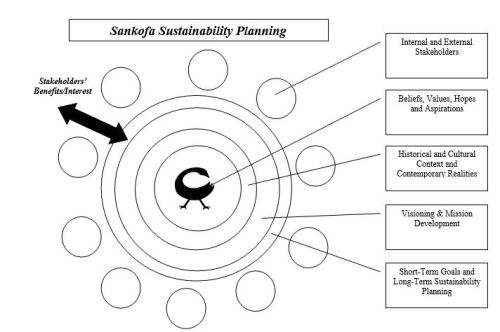
Sankofa Sustainability Graphic

An “Afrocentric” paradigm or approach to human service delivery for African Americans better articulates the value orientation of the constituency being served, as opposed to “generic” practice philosophies and approaches, which carry with them a value orientation that often ignores or fails to fully utilize cultural meaning systems to enhance service development and delivery. What service providers understand and believe about those they serve and the environment in which they live and work (premises) and how they conceptualize what will be most useful for client success (principles) has implications for both practice and service delivery. The importance of appropriate methodologies that take into account local contexts and needs should not be ignored. A human service organization’s capacity is directly tied to how well it is situated to work toward progressive social outcomes for those disadvantaged groups it is established to serve. This is made possible by progressive development philosophies that take into consideration culture, context, and connectedness. A more expansive and integrated development approach must include a  multilevel analytical framework that incorporates the strengths of the African American community and collaborative partnerships to achieve deeper level changes. Such approaches give valuable credence to values and meaning systems important to African Americans, resulting in more empowering practice.

3 Comments

Filed under Uncategorized

Organization Foundations: Vision and Mission

Organizational purposes, or vision statements, define an overall idea of how the community will be changed/better because an organization exists and based on a timeline in the distant but foreseeable future. That future could be five years, ten years, or twenty years out. It is important, though, that there is a predetermined point at which you would expect to see noticeable impact, and what that impact will be should be succinctly described in your purpose statement. The purpose statement should be inspiring, and should energize both your planning team or board of directors, and ultimately the community you will be serving. Your purpose or vision statement is not your mission statement. We’ll talk more about that later. However, a good purpose or vision statement will assist you in formulating the organization’s mission, as they are complementary in nature.

An organization’s mission statement clearly outlines the prime purposes of the work of the organization, including clearly identified markers and measures of success. The mission statement is both a declaration to those internal to the organization, as well as those without, to keep the organization on point as to what it hopes to achieve by any and all activities in which it engages.

The vision statement is equally important, but is more overarching, defining and declaring the operational values, guiding assumptions and beliefs that give impetus to the organization’s very existence. For internal stakeholders (board members, employees, volunteers, etc.), it provides inspiration and motivation, as well as expressing expectations for how each will behave and perform to exemplify the organization’s highest standards. For those external to the organization, it provides a rationale for partnership and collaboration, based on beliefs and values they also share.

In the next post, I will provide some simple exercises for you and your planning team to perform the work of developing a vision and mission statement.

1 Comment

Filed under Uncategorized

Nonprofit vs Business Venture: A Clear Distinction

I often get requests from individuals wanting assistance to start a nonprofit. Usually the requests come from individuals who genuinely feel they have a service to offer to others and need a vehicle for providing that service. Nevertheless, even those with a genuine desire to help are also thinking that starting a nonprofit will immediately position them to apply for and acquire grant funds to do the work, and more importantly, to pay THEM for doing the work. In a few cases, individuals really have entrepreneurial ideas, and want to find a way to fund them. So, I feel a need to clarify the distinction between a nonprofit and an entrepreneurial venture.

Many people misunderstand about nonprofits. Oftentimes, especially in difficult economic times, individuals think that starting a nonprofit is a way to garner additional personal income. The primary focus of nonprofits is to bridge the gap between unmet social/public needs. Nonprofit doesn’t mean that individuals who direct them or provide services through them can’t benefit (e.g. earn wages or a salary from the work they do). However, the IRS designation of a nonprofit is only given to organizations who are established for CHARITABLE PURPOSES or “exempt” purposes. The definition that the IRS uses for exempt purposes can be found here: http://www.irs.gov/charities/charitable/article/0,,id=96099,00.html.

In addition, no individual “owns” a nonprofit, as they cannot be operated for private interests, or to benefit those running the organization. Thus, nonprofits MUST have a governing boards of directors, who are primarily responsibility and LIABLE for all of the work of the organization. The buck stops with them. Generally, particularly in small, grassroots organizations, the board is unpaid, but have the responsibility to hire someone to direct the work of the organization. That paid staff works exclusively at the pleasure of the board, who also has responsibility for replacing them, if they are not able to effectively run the organization.

On the other hand, if you’re looking to start a business that will garner you personal income, that’s an entirely different playground, with totally different rules. In that case, your first steps will need to be conducting a feasibility study for your business, and then developing a well-researched business plan. With that in hand, if you don’t have the capital to finance it yourself, you have a tool for seeking willing investors. There are few, if any, grants (free money) available for for-profit ventures.

That being said, nonprofits CAN be entrepreneurial. There is this idea and concept called social entrepreneurship whereby entrepreneurial ideas and practices are utilized in the service of social change. But, we’ll talk more about that later….

Hope this was helpful! If you have questions, please feel free to leave them in the comments section. I’ll answer any and all that I can.

Leave a comment

Filed under Uncategorized

Grant Writer vs. Fund Development Coach

Grant Writer vs. Fund Development Coach:
Leveraging Scarce Resources to Increase Organizational Sustainability

In these current economic times, many if not most nonprofit organizations and nongovernmental organizations, throughout the U.S and abroad, struggle to maintain operations and services at pre-recession levels. In some cases, funding has all but dried up for some services and activities. Many of the major foundations, who have historically provided funds for new and novel community projects as well as support for traditional and tried and true organizational work, are finding their own coffers becoming increasingly limited in a post-Bernie Maddoff world. In a word or three, times are tight.

Add to the lean times, the fact that some organizations have had to downsize staff and/or staff hours, while at the same time seeing demand for services increasing. Historically, nonprofits have depended overwhelmingly on the grants funding from a variety of sources, including private donors, foundations and the various levels of government. However, accessing such resources always requires the work of a skilled grant writer or grant writing team. Ironically, when staff cuts happen, that person is often one of the first to go, as opposed to those providing direct services to the organizations clients and consumers.

But, you still need someone to help with finding and procuring funds. Some organizations outsource the work, hiring independent contractors to help search and apply for appropriate funding. Generally, independent grant writers work for a fee – either hourly and a percentage negotiated per job based on the size and complexity of the grant. Payment is always required in full, generally at the time the proposal is completed and submitted. No reputable grant writer will work on contingency – paid only if the proposal is ultimately funded. That’s just not good business sense.

This is a viable option for some organizations, depending on how much of the work of the organization is generally dependent upon grant funding. However, if the organization is surviving primarily from grants – never a good idea, but often the case – it can become very expensive to contract with someone to write several grants in a year’s time. On top of that, it does little to build the overall capacity of the organization — which is essential for the long-term sustainability of the organization. Additionally, in the never-ending search for funding, organizations run the risk of losing focus on their primary vision and mission as they adapt to what is increasingly becoming a funding marketplace, complete with its own economics. Organizations with human empowerment, social justice and social change agendas often find themselves challenged to compromise core organization values in order to continue to fund empowerment and social change activities. But, finding funders with similar core values, as well as the vision and passion to put their money where it can work is not the first job.

The creation of a comprehensive fund development plan is crucial to every organization. Generally, an organization will include some fund development strategies within its periodic strategic plan. However, a fund development plan is a more comprehensive plan that includes clear and quantifiable financial targets, identification of some potential and promising funding sources, clear-cut strategies for how those sources will be approached and accessed, and clearly defined responsibilities for members of the organization’s fund development team (which generally includes board members, executive and other staff and volunteers).

Organizational assessment is a critical part of fund development planning. In particular, organizational leaders need to determine the readiness of the organization for targeted fundraising

Another option holding considerable promise for both resource acquisition and organizational capacity building and sustainability is to contract with a fund development coach. Fund development coaches are usually successful grant writers, but more importantly, have the necessary skills to facilitate more comprehensive planning related to organizational funding needs. A fund development coach generally has two primary responsibilities: 1) facilitating organization stakeholders in the creation of a comprehensive fund development plan; and 2) building, training, coordinating and critiquing the work of an internal organization fund development team.

With a comprehensive plan, the fund development coach can then begin developing the team to work the plan. Developing the team can include providing group workshops or one-on-one training on all aspects of fundraising, from grant searching to initiating and nurturing relationships with potential donors. In addition, coaching can include oversight of and coordinating the team process of developing proposals (e.g. research, narrative development, evaluation design, and budget development),as well as review and critique of proposal components.

While fund development coaches work as independent contractors, with pay negotiated by the hour or per project, the benefit is that the goal is for organization members to gain valuable skills that remain with the organization even after the coach is no longer working directly with the organization. Utilizing a fund development coach can build the organization’s internal capacity, add value to and show appreciation for staff and volunteers, and more broadly distribute responsibility for the organization’s overall success. Ultimately this has the effect of improving the prospects for the organization’s long-term sustainability.

2 Comments

Filed under Uncategorized