
Introduction
Calling the elders!
 Antonio is a freshman in high school. He’s just been arrested and released after being involved in a fight with another youth at his school. A condition of his release, under a diversion protocol, is that he commit to regular school attendance, and improve his academic scores (he is an above-average math and science student, but is barely making it through English and History). He has to complete a conflict resolution course offered at the neighborhood center, and must not get any bad disciplinary reports from either his parents or his school. If he can fulfill these conditions, his record will be wiped clean of the arrest. However, if he cannot, he runs the risk of being placed out-of-home in a more structured disciplinary environment. Antonio’s mother is a single parent, working a job and a half to support Antonio and his two younger sisters. She is a high school graduate, with a year of college, but never completed her post-high school education after becoming pregnant with Antonio, whose father left soon after he was born. His two younger sisters have a different father, who is not active in their lives either. She doesn’t really have the time or resources to strictly monitor Antonio, who is not a “bad” kid, but doesn’t really have the kind of structure at home that allows him to fully develop. Antonio’s mother wants him to succeed at his diversion, but worries that she won’t be able to provide the structure and support he needs, based on her work hours.
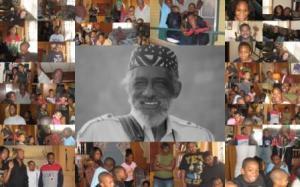
Baba Jihad Muqtasid - First Presiding Elder Wichita COE
Enter the elders: Through a cooperative agreement with the county’s Juvenile Justice Authority, the Council has agreed to assist Antonio and his family to meet the requirements of his diversion in a number of ways. But most important, they exemplify the values like truth, honesty, balance, justice. Reciprocity. Self-knowledge. They help him regain his mind and envision a reality beyond his current circumstances. They make it a family thing, and extend support to the entire family, with full intention of bringing them through and keeping them strong, in order to entrust them with our continuance.
They meet with Antonio and his family to get a sense of their circumstances. Next, they work with Antonio to find out if he has goals beyond the diversion, and what those are. The Council and Antonio’s family develop accountability agreements — Council members connect the family with community resources that can assist in Antonio’s success: a mentor, a tutor for English and History, transportation to and from the community center, and even childcare and enrichment activities for his younger sisters while he is occupied with studies and counseling. In addition, the Council connects Antonio’s mother with a parenting support group and parent mentor, to provide some support for her efforts at raising her three children. And through the elders personal and professional connections they are able to assist her to find more lucrative employment, so that toward the end of the six-month diversion period, she is able to give up her part-time job. For the most part, the Council does not provide any of these services directly, but through relationships that they’ve built with resource providers in the community, they are able to make appropriate referrals and follow-up on those referrals regularly. When problems arise, they work with Antonio’s family and the service providers to resolve them. Everyone is focused on achieving success for Antonio and his family.
Calling the elders!
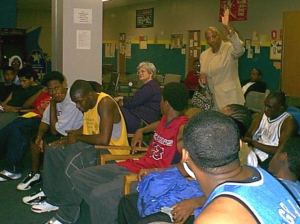 In the community where the Council serves, there are at least two dozen human service agencies and organizations providing services that range from youth development to ex-offender release programs. All of the organizations have as part of their mission to provide culturally appropriate programming for residents of this predominantly black community. All struggle regularly with financial resources to deliver their services, but rarely is anyone turned away who needs help. Some of the agencies and organizations offer the same or similar services, with their own special focus, for example, there are three substance abuse treatment agencies, but one focuses primarily on women’s recovery, another focuses on ex-offender drug treatment and the other has had great success working with teens. In addition, one of the youth development organizations is skilled at employing computer technology and Internet social networking to enhance services, and another has an outstanding grant writer.
A funding opportunity is on the horizon for a comprehensive community development initiative; however, no single organization in the community can truthfully say they have the organizational capacity to fulfill the requirements of the grant. On the other hand, there is a large white agency in the city that could probably fulfill the requirements, but they have not previously expressed a commitment to culturally appropriate programming, and in fact, only have one black employee in the agency. The Council calls a meeting of all of the organizations, and together, they go through a facilitated process to identify strengths, challenges and resources available within the community.
Together, they develop guiding principles for how they can work together and with potential service recipients, develop strategies for cross-referrals and supportive services for each agency. Through a process of open dialogue and honest communication, they are able to ultimately develop cooperative agreements for working together. Based on this, a lead organization is chosen to apply for the funding, with several of the other organizations included as collaborative partners. They agree that, whether or not they are awarded the grant, they will stay committed to working collaboratively to meet the needs of those they serve. The Council is assigned and commits to the task of bring the group together regularly to review needs, issues, and opportunities for training, funding and other capacity-building efforts.
Calling the elders!
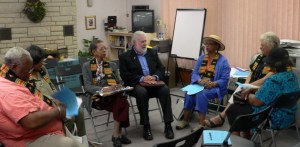
Wichita Elders meet with County Commissioner
A proposed City-sponsored community development project will create new housing and commercial development in an older area of the community in much need of rehabilitation. An out-of-state urban planning consultant has proposed a plan that would displace and out-price many of the current residents in the area. A local planning consultant familiar with the community has proposed a plan that will build on the natural rhythm of the neighborhoods, concerned with maintain a balance between the new and the traditional. Focusing on families and extended families. Neighborhood. Neighborhood residents request an opportunity to review and comment on both proposals, but the City is reticent to open up the process and have tentatively chosen the out-of-state contractor based on their extensive work on similar projects. After taking their concerns to the elders, the elders lead and support community residents to demand that the City meet with them in the neighborhood, and present both plans for public comment. The City concedes, and after hearing passionate but rational concerns presented by the neighborhood residents, the City agrees to set up and train a local development group made up of at least half neighborhood residents to negotiate with the out-of-state consultant to mentor the local consultant and others, with the understanding that the project will stay under local, community control and residents will have a voice in the development project.
Is this your community? Could it be? As we move further into a new millennium, it is critical that we not leave behind those things and resources that have been so instrumental in the survival of black families over time. The elders are one of those resources. Are we utilizing the elders in our communities to assist efforts at community and family strengthening? Or, are we missing the opportunity to take advantage of what has historically been one of our most valuable resources?
Yeo, et al (1999) performed a cohort analysis of African American elders through the ages, going back to 1900, to provide a sense of the historical markers that have impacted the lives of African Americans, and thus, what history elders from a range of age group cohorts hold as knowledge based on lived experiences. This rich reservoir of knowledge is an asset that can be drawn upon to frame the contemporary experiences of black people in our local communities and throughout our nation. Today’s elders, age 55 and older, have lived through Jim Crow, the Klan, the founding of the NAACP, the Great Depression, the Harlem Renaissance, the Montgomery Bus Boycott, two World Wars, as well as the Civil Rights and Black Power movements, the Million Man and Million Woman marches and to see the first African American elected president of the United States. Their experiences have been varied, based on where they lived and learned in the United States, their education and socioeconomic status, cultural origins, religious affiliations and other environmental factors. All this has gifted them with a plethora of knowledge based on their lived experiences and their placement in society. Each one has much to offer new generations of black youth and families. They are living histories of our sojourn as a people in these United States. They have many stories waiting to be told, if only we would invite them to share. They have much to teach us, if we would become willing students. Their experience can be our support and our guide, if we would create the space for them to continue to learn and grow with us in the new millennium.
We have but to call them.
This guidebook is not meant to be merely theoretical discourse or food for thought. It is intended as a guide and workbook, designed for those interested in our continuance, and willing to put in the necessary work to develop one avenue toward that end. In it you will find practical transformative concepts, steps, and processes for ways to engage our entire community in reconnecting the links that have historically been our strength. It is encouragement to make the call that could mean the difference between our annihilation or our continued longevity. It’s in your hands. Will you make the call?
To order the guide and toolkit, go to: http://bit.ly/bb7MRA
For more information on starting a council of elders in your community, please provide e-mail address below and/or contact me at orgdoc@transformingconcepts.com.
We CAN be the change we want to see in the world!
 Transformative Concepts Consulting Group
i find this writing provocative and compelling. And this for me asks the question that always needs to be asked. Do programs, agencies, etc solve human problems or are our mutual problems solved by becoming involved and connected in each others’ lives in ways that are tangible, and more oft than not, require us to GET unclean, dirty…be intimately involved, love, connect, relationally. Am i guilty of not doin so, wanting to go home plug in, zone out, yes…it is always someone else’s problem..or is it………..thanks Dr. MT.
What age constitutes an elder or is being an elder demonstration of wisdom?
“Elders” are those who have attained the age of 60.
But age is not the single determining factor for Eldership.
In our African American Council of Elders, one must have achieved and or accomplished something in their own lives and moreover, having contributed to the furtherance of the culture, history and heritage of the Black community.
Eldership demostrates leadership, education, cultural awareness, a willingness to be and promote inter-generational awaeness, a personal need for spiritual growth, seeing Mother Africa in themselves, be aware that being born African in America is a good thing, knowing, with the same certainty you know your Mother’s name that your DNA beats in the veins of millions of Africans born and yet to be born and that our common (to us all) ancestors are looking down… waiting